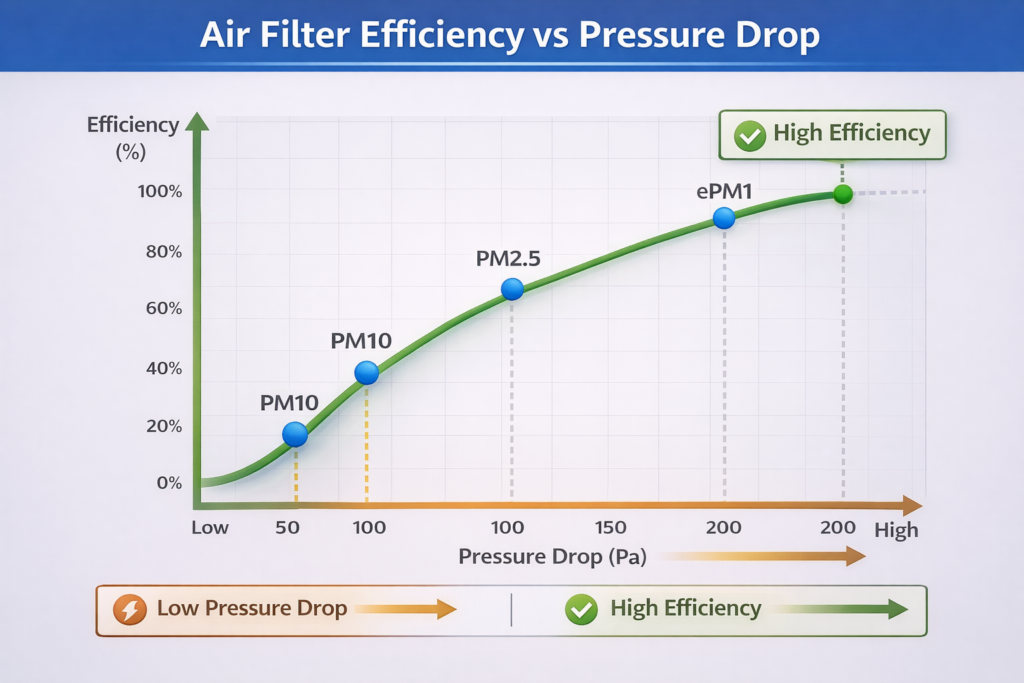
Air filter performance standards vary across regions, mit ISO 16890 widely used internationally, Und ASHRAE 52.2 commonly applied in North America.
Understanding the differences between these two standards is essential for manufacturers, engineers, and laboratories working in global markets.
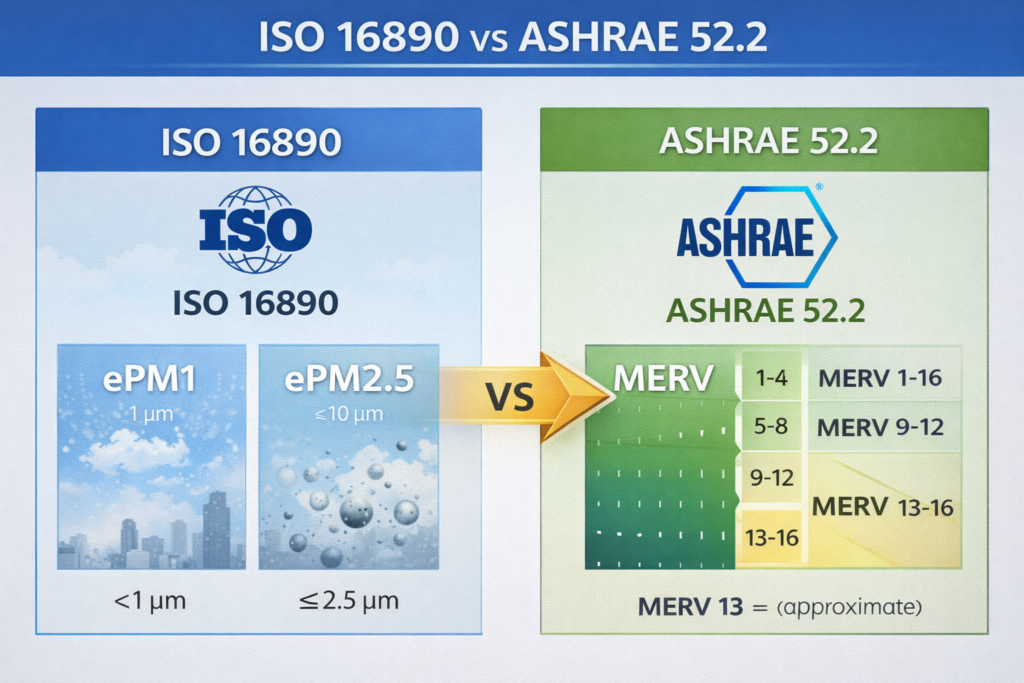
1. Overview of ISO 16890 und ASHRAE 52.2
ISO 16890
- International standard
- Based on particulate matter (PM1, PM2,5, PM10)
- Reflects real-world air pollution
ASHRAE 52.2
- Developed by the American Society of Heating, Refrigerating and Air-Conditioning Engineers
- Uses MERV (Minimum Efficiency Reporting Value) rating
- Based on particle size efficiency ranges
2. Classification Systems Compared
| Standard | Classification Method |
|---|---|
| ISO 16890 | ePM1 / ePM2.5 / ePM10 / Grob |
| ASHRAE 52.2 | MERV 1–16 |
👉 Beispiel:
- MERV 13 ≈ ePM2.5 (approximate)
- MERV 16 ≈ ePM1 (approximate)
⚠️ Hinweis: These are not exact equivalents.
3. Hauptunterschiede
3.1 Basis of Evaluation
- ISO 16890 → Real-world PM sizes
- ASHRAE 52.2 → Particle size efficiency bands
👉 ISO 16890 is more directly linked to air pollution and health.
3.2 Testing Approach
ISO 16890:
- Includes discharge process
- Includes dust loading
- Calculates average efficiency
ASHRAE 52.2:
- Focuses on initial and conditioned efficiency
- Uses standardized test dust
- Does not directly classify based on PM
3.3 Global Application
| Region | Common Standard |
|---|---|
| Europa | ISO 16890 |
| Asia | ISO 16890 |
| USA | ASHRAE 52.2 |
| Middle East | Both |
3.4 Real-World Relevance
ISO 16890 bietet:
✔ Better correlation with PM pollution
✔ More intuitive filter selection
ASHRAE 52.2 bietet:
✔ Simple and widely recognized MERV ratings
4. Which Standard Should You Use?
Choose ISO 16890 if:
- You operate in global markets
- You focus on PM-based air quality
- You need internationally recognized data
Choose ASHRAE 52.2 if:
- Your primary market is North America
- You need MERV classification
- Your customers require it
👉 Many manufacturers now test according to both standards to meet global demand.
5. Challenges in Cross-Standard Comparison
Comparing ISO 16890 und ASHRAE 52.2 is not straightforward because:
- Different test methods
- Different classification logic
- Different evaluation metrics
👉 Direct conversion is only approximate and should be used carefully.
6. Bedeutung genauer Tests
To meet both standards, test systems must provide:
- Stabiler Luftstrom
- Präzise Partikelmessung
- Reliable efficiency calculation
👉 Any inconsistency can lead to incorrect classification under either standard.
7. Empfohlene Testlösung
Der SC-16890 Allgemeines Lüftungsfiltertestsystem from SCPUR can be configured to support international testing requirements.
Hauptvorteile
- Accurate PM-based measurement (ISO 16890)
- Flexible system configuration
- Hohe Wiederholgenauigkeit
- Reliable performance
👉 Suitable for manufacturers targeting global markets.
8. Abschluss
Both ISO 16890 und ASHRAE 52.2 play important roles in air filtration standards worldwide.
- ISO 16890 focuses on real-world particle removal
- ASHRAE 52.2 provides a widely used MERV rating system
For companies operating internationally, understanding and applying both standards is essential.