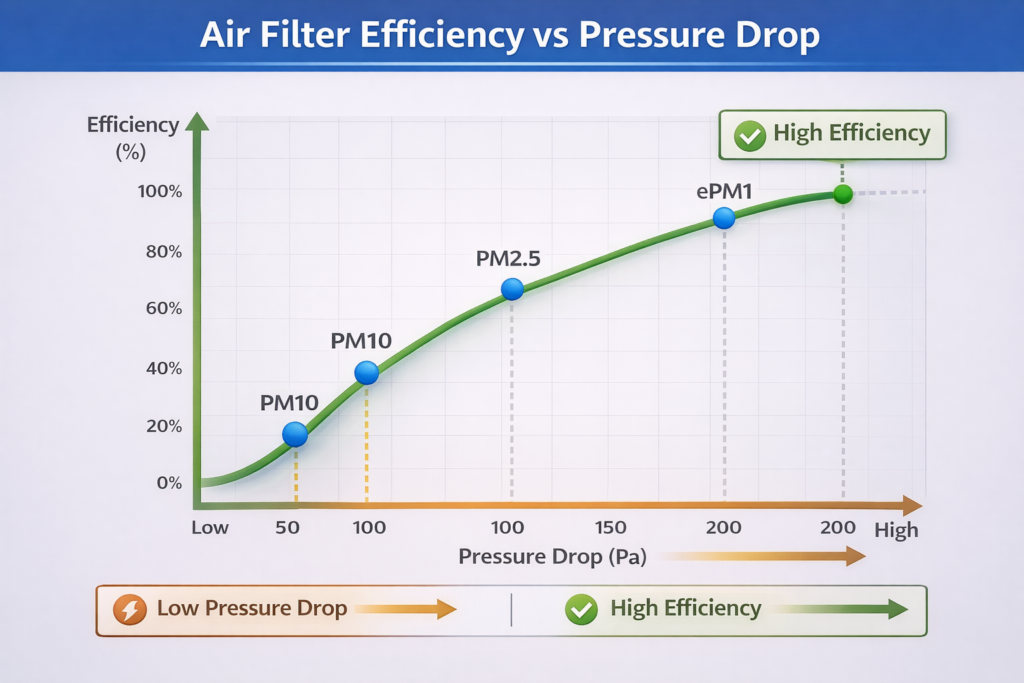
Air filter performance standards vary across regions, con ISO 16890 widely used internationally, E ASHRAE 52.2 commonly applied in North America.
Understanding the differences between these two standards is essential for manufacturers, engineers, and laboratories working in global markets.
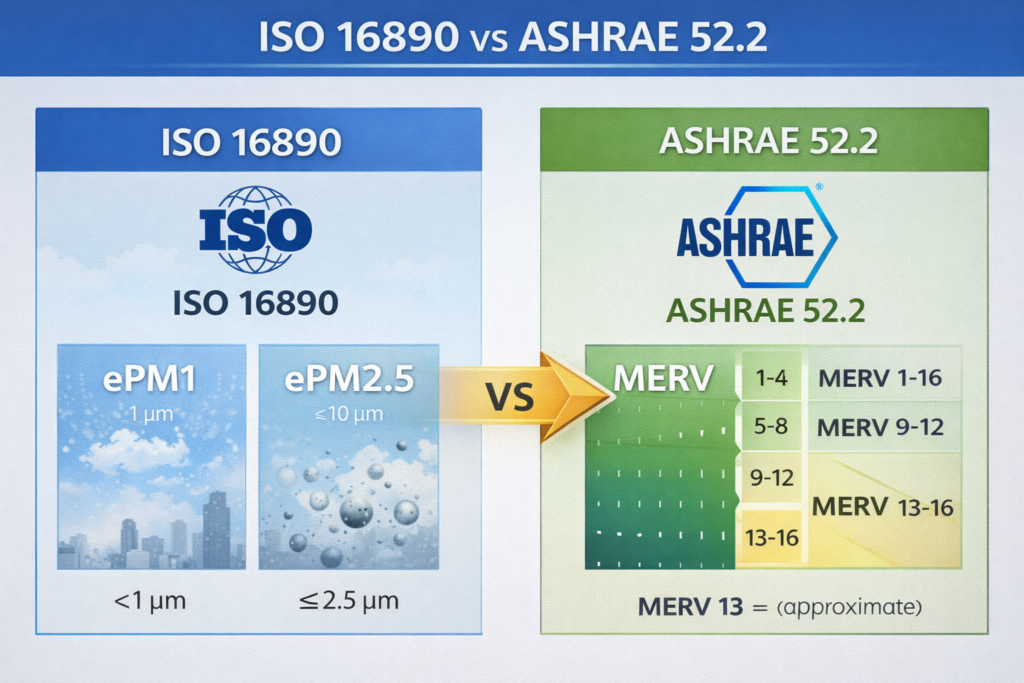
1. Panoramica dell'ISO 16890 e ASHRAE 52.2
ISO 16890
- International standard
- Based on particulate matter (PM1, PM2,5, PM10)
- Reflects real-world air pollution
ASHRAE 52.2
- Developed by the American Society of Heating, Refrigerating and Air-Conditioning Engineers
- Uses MERV (Minimum Efficiency Reporting Value) rating
- Based on particle size efficiency ranges
2. Classification Systems Compared
| Standard | Classification Method |
|---|---|
| ISO 16890 | ePM1 / ePM2.5 / ePM10 / Grossolano |
| ASHRAE 52.2 | MERV 1–16 |
👉Esempio:
- MERV 13 ≈ ePM2.5 (approximate)
- MERV 16 ≈ ePM1 (approximate)
⚠️ Nota: These are not exact equivalents.
3. Differenze chiave
3.1 Basis of Evaluation
- ISO 16890 → Real-world PM sizes
- ASHRAE 52.2 → Particle size efficiency bands
👉 ISO 16890 is more directly linked to air pollution and health.
3.2 Testing Approach
ISO 16890:
- Includes discharge process
- Includes dust loading
- Calculates average efficiency
ASHRAE 52.2:
- Focuses on initial and conditioned efficiency
- Uses standardized test dust
- Does not directly classify based on PM
3.3 Global Application
| Region | Common Standard |
|---|---|
| Europa | ISO 16890 |
| Asia | ISO 16890 |
| USA | ASHRAE 52.2 |
| Middle East | Both |
3.4 Real-World Relevance
ISO 16890 fornisce:
✔ Better correlation with PM pollution
✔ More intuitive filter selection
ASHRAE 52.2 fornisce:
✔ Simple and widely recognized MERV ratings
4. Which Standard Should You Use?
Choose ISO 16890 if:
- You operate in global markets
- You focus on PM-based air quality
- You need internationally recognized data
Choose ASHRAE 52.2 if:
- Your primary market is North America
- You need MERV classification
- Your customers require it
👉 Many manufacturers now test according to both standards to meet global demand.
5. Challenges in Cross-Standard Comparison
Comparing ISO 16890 e ASHRAE 52.2 is not straightforward because:
- Different test methods
- Different classification logic
- Different evaluation metrics
👉 Direct conversion is only approximate and should be used carefully.
6. Importanza di test accurati
To meet both standards, test systems must provide:
- Flusso d'aria stabile
- Misurazione accurata delle particelle
- Reliable efficiency calculation
👉 Any inconsistency can lead to incorrect classification under either standard.
7. Soluzione di test consigliata
IL SC-16890 Sistema di test generale del filtro di ventilazione from SCPUR can be configured to support international testing requirements.
Vantaggi principali
- Accurate PM-based measurement (ISO 16890)
- Flexible system configuration
- Alta ripetibilità
- Reliable performance
👉 Suitable for manufacturers targeting global markets.
8. Conclusione
Both ISO 16890 e ASHRAE 52.2 play important roles in air filtration standards worldwide.
- ISO 16890 focuses on real-world particle removal
- ASHRAE 52.2 provides a widely used MERV rating system
For companies operating internationally, understanding and applying both standards is essential.