>

博客

>

了解ISO 16890: ePM1 的测试方法 / ePM2.5 / 粗效率和设备要求

了解ISO 16890: ePM1 的测试方法 / ePM2.5 / 粗效率和设备要求

分享:

目录

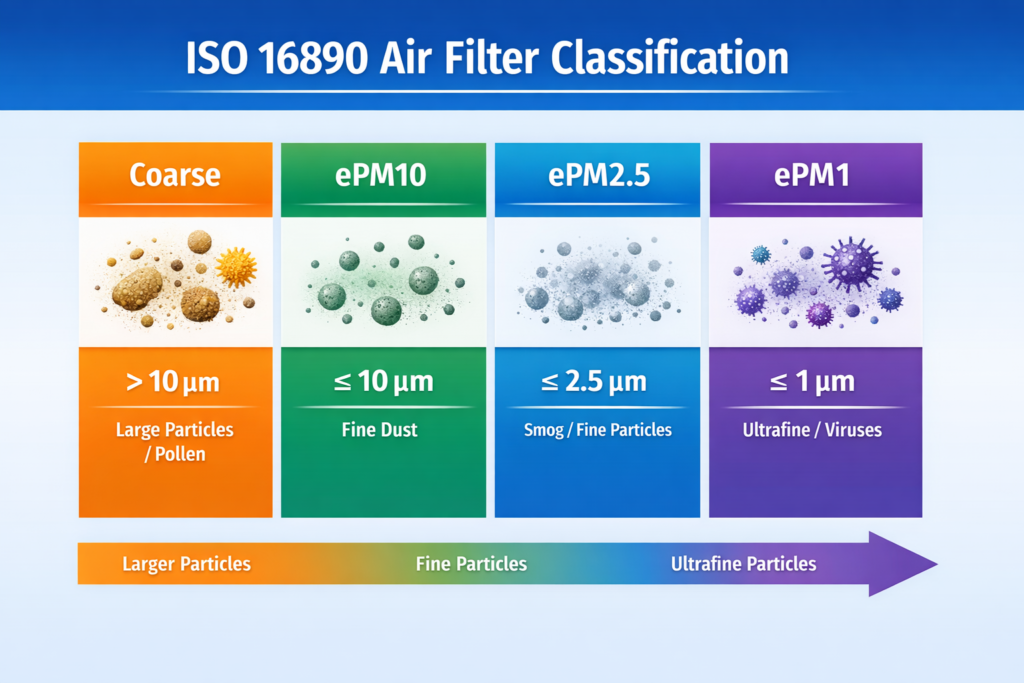
In modern air filtration applications, users are increasingly concerned with how well filters remove particles in the PM2.5 and PM10 size ranges. 国际标准化组织 16890 is now the leading international standard for evaluating air filter performance for general ventilation.

This article provides a clear explanation of how ISO 16890 defines and measures ePM1, ePM2.5, 电子PM10, and Coarse filtration efficiencies, as well as key topics such as aerosol types, particle size classification, data processing, and equipment design requirements.

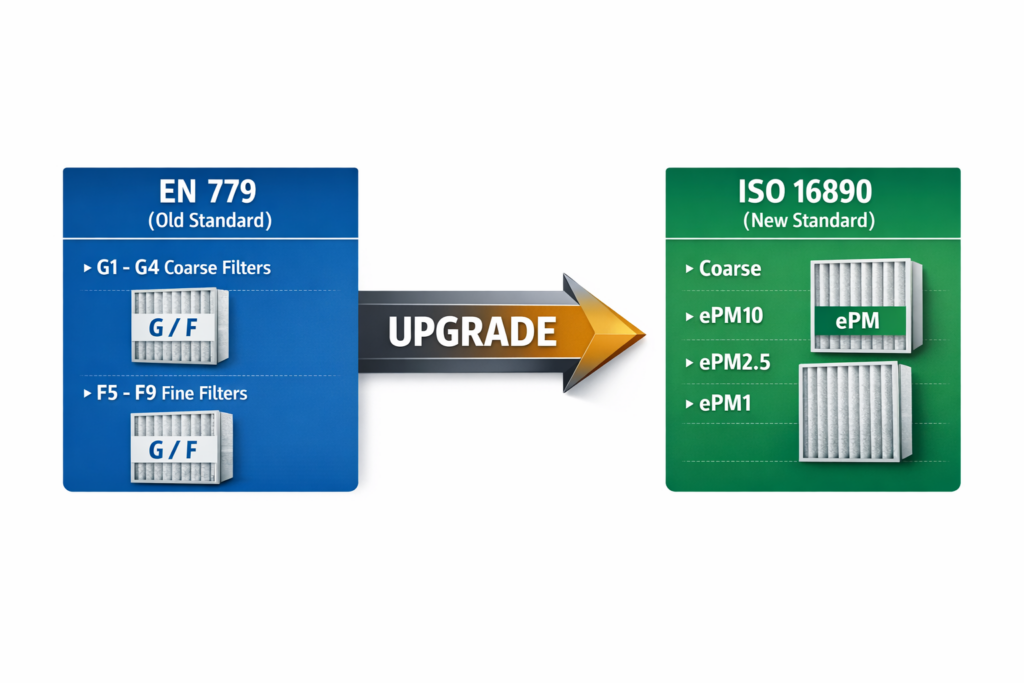
Why Move from EN779 to ISO 16890?

国际标准化组织 16890 was developed to replace EN779 in order to establish a more realistic and globally harmonized testing method for air filters. It reflects real-world performance better by:

Measuring efficiency across a range of particle sizes (not just 0.4 μm)

Providing classification based on PM1, PM2.5, and PM10 mass efficiency

Offering results that correspond to actual environmental air quality metrics

Why Introduce IPA Neutralization?

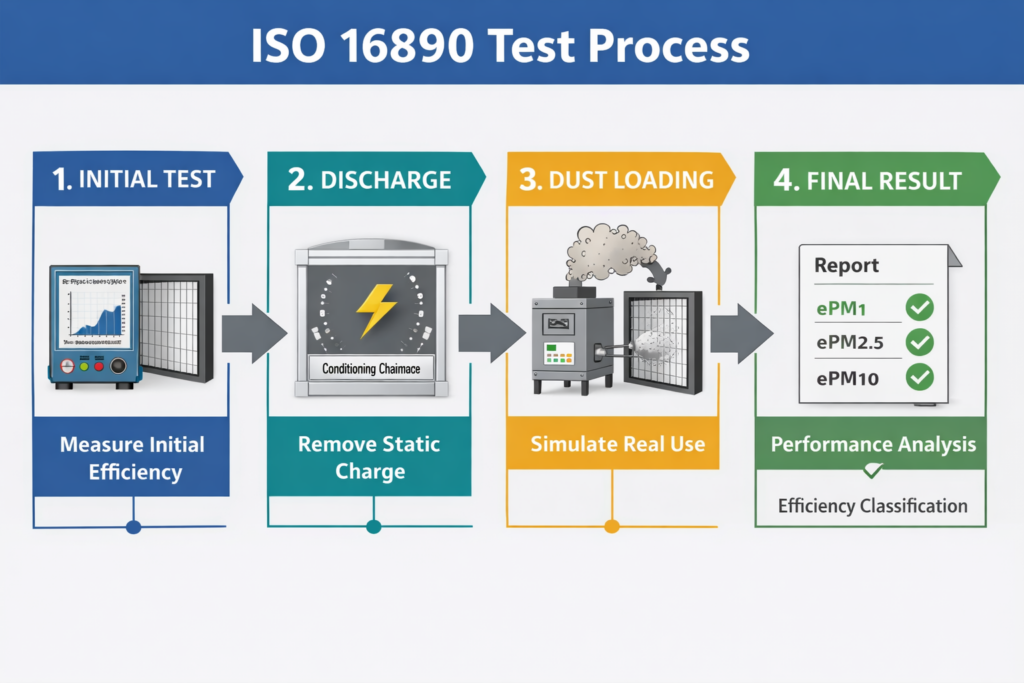
Many modern filters use electrostatic charge to enhance initial efficiency. However, these effects can degrade quickly in real use due to humidity, aging, or dust loading. 国际标准化组织 16890 introduces IPA vapor treatment to eliminate this charge and determine the minimum efficiency—the worst-case performance based purely on mechanical filtration.

By averaging the initial and minimum efficiency, the classification becomes:

More realistic to long-term performance

More consistent and comparable

Fairer across different media types (electrostatic vs. mechanical)

Aerosol Types: DEHS and KCl

To test across the full range of relevant particle sizes, 国际标准化组织 16890 recommends using:

Aerosol TypeParticle Size Range (μm)Purpose
DEHS0.3 1.0Fine particles (电子PM1)
KCl1.0 10.0Medium to large particles (ePM2.5, 电子PM10)

This dual-source approach ensures coverage of the full 0.3–10 μm range.

Particle Size Distribution and Instrument Requirements

The ISO 16890 test defines 13 particle size bins from 0.3 to 10 μm. Filters are evaluated on how efficiently they remove particles in these bins, with weighted mass efficiencies calculated for each level (电子PM1, ePM2.5, 电子PM10).

BinSize Range (μm)
10.30 0.40
20.40 0.55
30.55 0.70
40.70 1.00
51.00 1.30
61.30 1.60
71.60 2.20
82.20 3.00
93.00 4.00
104.00 5.50
115.50 7.00
127.00 8.50
138.50 10.00

Efficiency range breakdown:

电子PM1: weighted over bins 1–4 (0.3–1.0 μm)

ePM2.5: bins 1–7 (0.3–2.5 μm)

电子PM10: all bins 1–13 (0.3–10.0 μm) Instruments must:

Detect particles across 0.3–10 μm

Resolve at least 12–13 size channels as defined

Count ≥500 particles per bin to ensure statistical accuracy

Recommended tools include optical particle counters (OPC), aerodynamic particle sizers (APS), and advanced multi-channel systems.

ePMx Calculation Method

ePMx Calculation Method

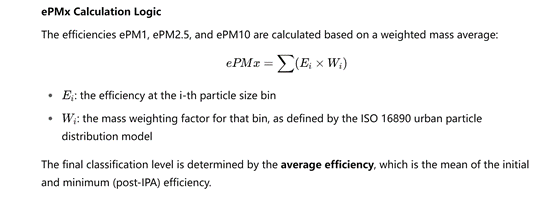
The efficiencies ePM1, ePM2.5, and ePM10 are calculated based on a weighted mass average:

Ei: the efficiency at the i-th particle size bin.

Withe mass weighting factor for that bin, as defined by the lSO 16890 urban particledistribution model.

ePMx 的计算逻辑

The final classification level is determined by the average efficiency, which is the mean of the initialand minimum (post-lPA) efficiency.

IPA Treatment: Controlling for Electrostatic Effects

Filters that rely on electrostatic charge can lose efficiency over time. To ensure consistent and fair classification, 国际标准化组织 16890 requires the filter be exposed to IPA vapor before testing to eliminate this charge. This gives the minimum efficiency, reflecting worst-case mechanical-only performance.

The average of initial and minimum efficiency is then used to assign ePM1, ePM2.5, or ePM10 classification levels.

ISO Coarse Filters: When ePM10 < 50%

If a filter’s ePM10 efficiency is less than 50%, it cannot be classified as ePM1–10. Instead, it is tested for

gravimetric (weight-based) efficiency:

  1. Load with ISO A2 dust
  • Measure mass before and after loading
  • Determine:

Initial gravimetric efficiency

Dust holding capacity before reaching final resistance

What Does the Final Report Include?

Initial, minimum, and average efficiencies

ePM classification (电子PM1, ePM2.5, 电子PM10)

Particle size efficiency distribution chart

Dust loading curve and pressure drop evolution

Gravimetric results for Coarse classification

Key Features Required for Testing Equipment

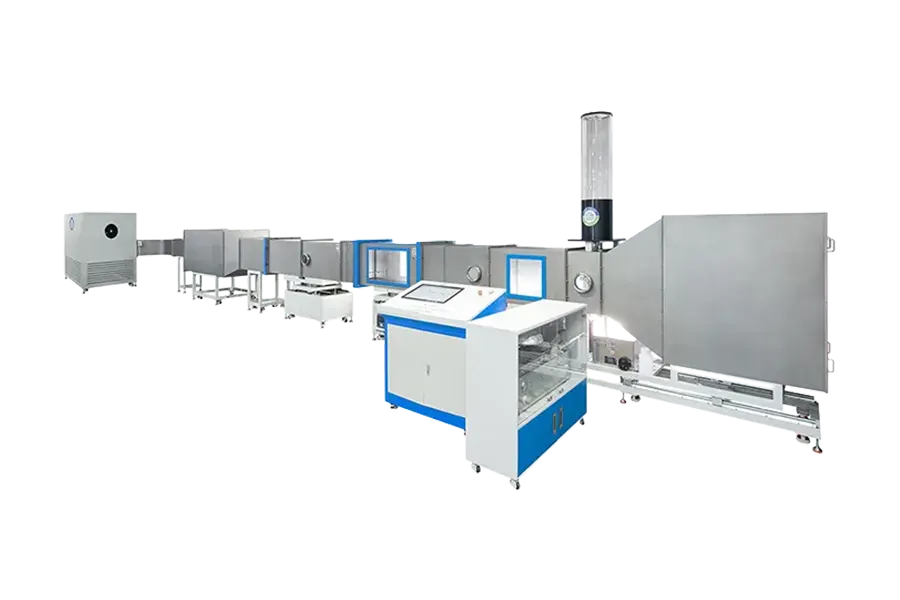
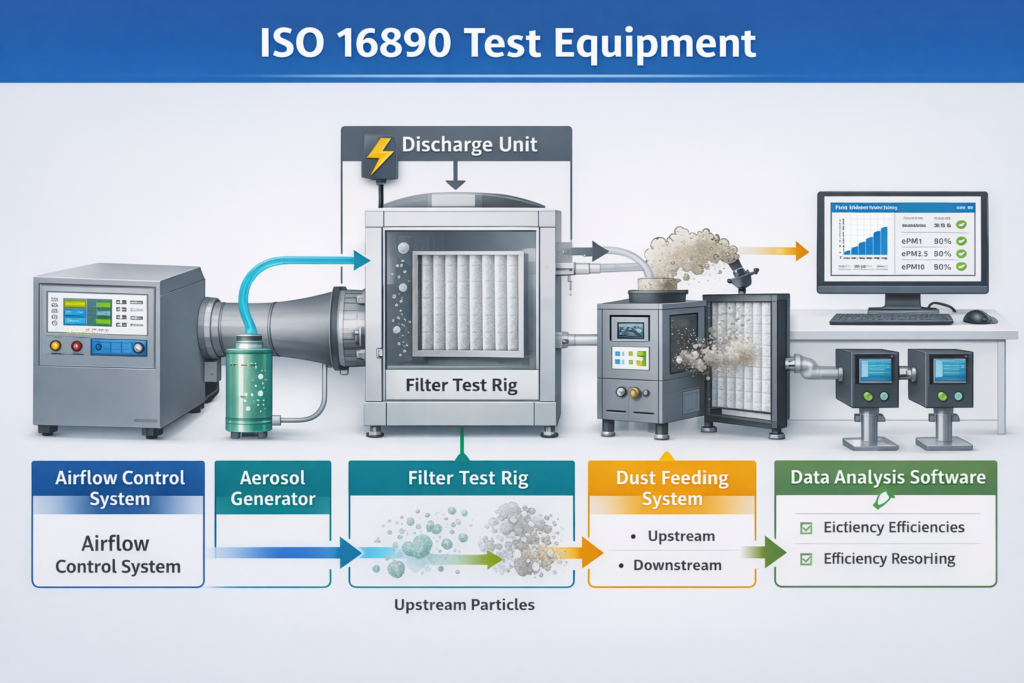
To comply with ISO 16890, a test system should include the following core modules:

Duct and fan system: Provides stable and adjustable test airflow (typically 500–4500 m³/h) while maintaining uniform velocity across the filter face.

Oil and salt aerosol generators: Capable of generating stable particle output for both DEHS and KCl. For large particles (例如, 10 μm KCl), the system must produce ≥500 particles per minute per size channel.

Dust loading system: Supports continuous injection of ISO A2 test dust, with an integrated weighing system that automatically captures and records dust mass before and after loading.

Particle counter: Must support sampling across the 0.3–10 μm range with 12 or more defined size bins to ensure resolution meets ISO classification standards.

Data calculation and control system: Coordinates fan and generator operations, links to particle counters and dilution systems, and automatically performs upstream/downstream switching, efficiency calculation, average efficiency determination, and report generation.

Conclusion

国际标准化组织 16890 使空气过滤器测试更接近真实世界的性能预期. 通过理解其分类逻辑, 测试程序, and instrumentation demands, manufacturers can design better filters—and users can better trust the performance labels they rely on.

For more information on ISO 16890 systems, test configurations, or full demo reports, contact us directly.

联系我们

热门博客

我们似乎找不到您要找的东西.

在你走之前...

不确定哪个国际标准适用于您的项目? 与我们的高级工程师交谈,根据我们 10 年的行业专业知识进行个性化的技术评估.

*我们尊重您的机密性,所有信息都受到保护.

使用全球标准测试系统验证您的质量

我们的专家随时准备为您设计定制解决方案. 告诉我们您的项目, 让我们以精确度和速度验证您的质量.

定制R&D & 量身定制的解决方案

定制R&D & 量身定制的解决方案

符合全球标准

符合全球标准

100% 自主研发的软件系统

100% 自主研发的软件系统

远程校准 & 全球支持

远程校准 & 全球支持

联系我们

*我们尊重您的机密性,所有信息都受到保护.