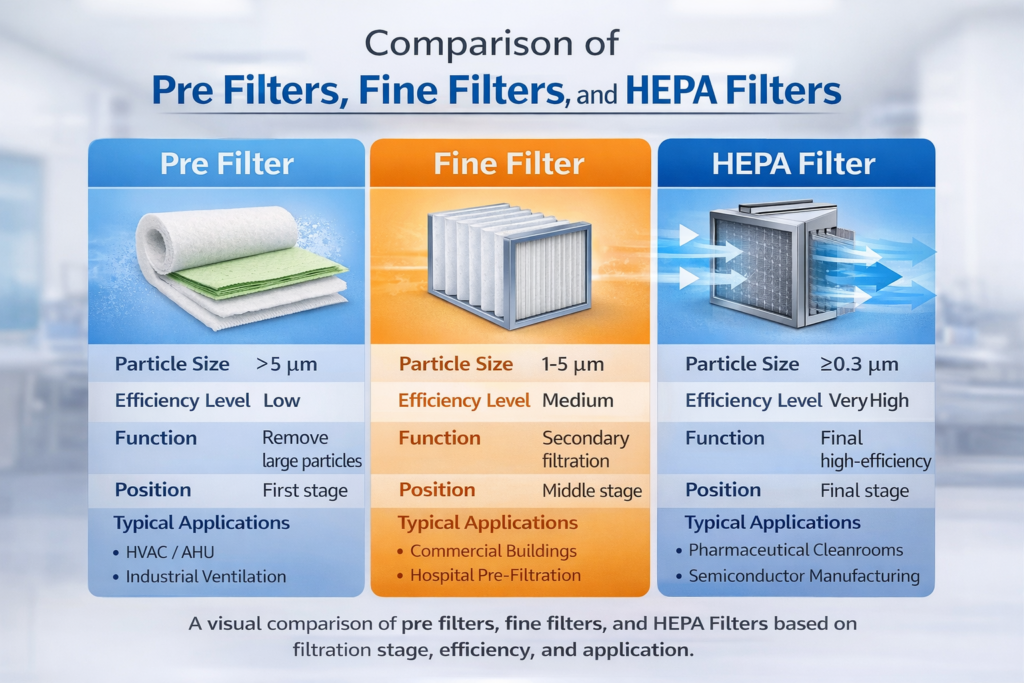
Whether in cleanroom environments for biomedical, semiconductor, and electronics industries, or in HVAC systems for offices, 机场, and residential buildings, air filtration systems do not rely on a single filter type. 反而, they use a multi-stage filtration strategy, combining different classes of filters to achieve optimal air quality and system performance.
1. The Role of Filters in Air Filtration Systems
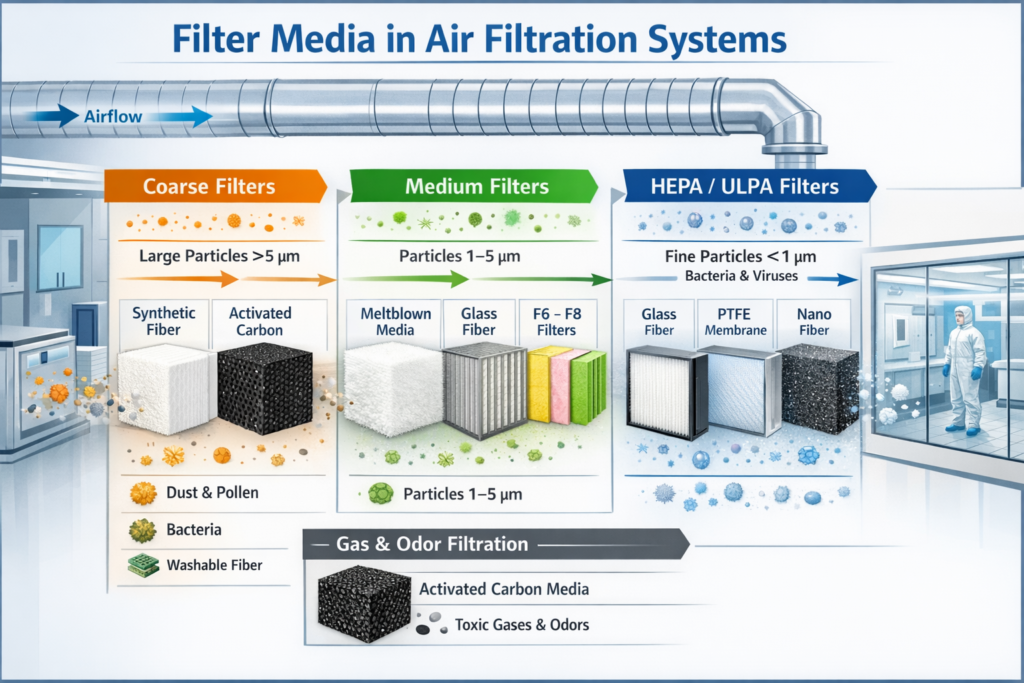
In most air filtration systems, especially cleanroom applications, pre-filters are installed upstream of HEPA/ULPA filters. Their primary function is to capture larger particles and protect high-efficiency filters.
As dust accumulates on HEPA filters, pressure drop increases. Once it begins to affect airflow performance, the filter must be replaced. While increasing filter area or quantity can extend service life, these solutions are limited by system design constraints.
👉 The most effective and economical solution is proper pre-filtration.
- Pre-filter replacement is simple and typically does not require system downtime
- Reduces operational cost by extending HEPA filter lifespan
- Improves overall system stability
Typical applications:
- Class 10,000–100,000 cleanrooms: commonly use F8 filters
- Higher-grade cleanrooms (Class 100–10): typically use H10 or even HEPA pre-filtration
暖通空调 & Public Building Applications
In HVAC and residential systems, filters are easier to replace and do not require shutdown.
After the COVID-19 pandemic, filtration standards in public buildings significantly improved. Many air outlets that previously lacked filtration were upgraded to include filters capable of capturing:
- Particulate matter
- Bacteria
- Viruses
This shift highlighted the importance of proper filter selection and media performance in ensuring indoor air safety.
2. Filter Media for Different Filter Classes
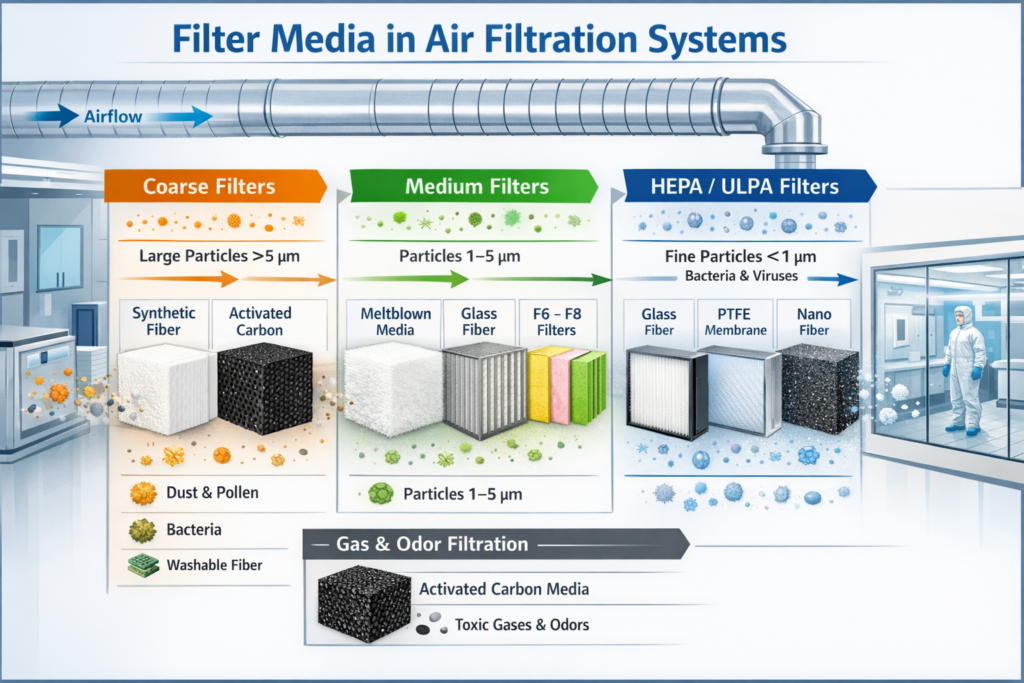
The performance of any filter is fundamentally determined by its 过滤介质 (material). Different filter classes rely on different materials to achieve specific filtration goals.
2.1 Coarse Filtration Media
Common materials:
- Synthetic fibers (PP)
- Washable artificial fibers
- Activated carbon
- High-temperature glass fiber
Key characteristics:
- Capture particles > 5 微米
- High airflow capacity
- Low pressure drop
- High dust holding capacity
⚠️ Note: Washable filters lose efficiency after cleaning and are typically recommended for limited reuse (1–2 cycles) only.
2.2 Medium Efficiency Filtration Media
Common materials:
- Synthetic fibers
- Melt-blown composites
- Ultra-fine glass fiber
Performance range:
- Particle size: 1–5微米
- Large surface area
- High dust holding capacity
- Optimized for moderate airflow
Typical classification (color coding):
- F5: Yellow
- F6: Green
- F7: Pink
- F8: Light yellow
- F9: White
2.3 高效空气过滤器 / ULPA Filter Media
Common materials:
- Glass fiber
- PTFE membrane
- Nano-fiber materials
These materials are designed to capture:
- 细颗粒 (<1 微米)
- Bacteria and viruses
HEPA/ULPA filters are typically installed as the final filtration stage, directly determining whether required cleanliness levels are achieved in critical environments.
In recent years, melt-blown nonwoven materials—originally used in masks—have also been adapted for filtration applications due to market oversupply and material versatility.
Special Case: Gas & Odor Filtration
For applications involving:
- Toxic gases
- Odors
Activated carbon media is required, as particle filters alone are not effective for gas-phase contaminants.
3. Why Filter Media Matters
Filter media is the core component of any air filter and directly impacts:
- Filtration efficiency
- 压降 (energy consumption)
- 容尘量
- Service life
Ultimately, filter media determines:
✔ Whether cleanroom standards can be achieved
✔ Indoor air quality in public and residential spaces
✔ Total cost of ownership (TCO) of the air system
4. The Importance of Filter Media Testing
Accurate testing of filter media is essential to ensure:
- Consistent product quality
- Compliance with standards
- Reliable system performance
SC-FT-1406D-Pro Series Filter Media Testers
Our 1406D-Pro series is designed to cover a wide range of filter materials and efficiency levels:
| Model | Filtration Efficiency | Filter Media Tested |
|---|---|---|
| 1406DL-Pro | 0–99% @ 0.3 微米 | Filter paper, filter cotton |
| 1406D-Pro | 45–99.99% @ 0.3 微米 | Melt-blown, 玻璃纤维 |
| 1406DH-Pro | 99–99.99995% @ 0.3 微米 | Fiberglass, 聚四氟乙烯, nano fiber |
| 1406DU-Pro | 99–99.9999995% @ 0.1 微米 | HEPA/ULPA media |
These systems help manufacturers optimize material performance, improve product quality, and meet industry standards.
5. 结论
Efficient air filtration systems depend not only on filter configuration but, more importantly, on the selection and performance of filter media.
From coarse filters to ULPA filters, each stage plays a critical role—but it is the material itself that ultimately defines system efficiency, 可靠性, and cost.
For this reason, scientific testing and proper media selection are essential for any high-performance air filtration system.