Air filtration is essential for maintaining indoor air quality in HVAC systems, commercial buildings, and industrial environments. To evaluate filter performance under real-world conditions, the global standard ISO 16890 was introduced.
This standard has replaced older systems and is now the most widely used method for classifying general ventilation air filters.
1. What is ISO 16890?
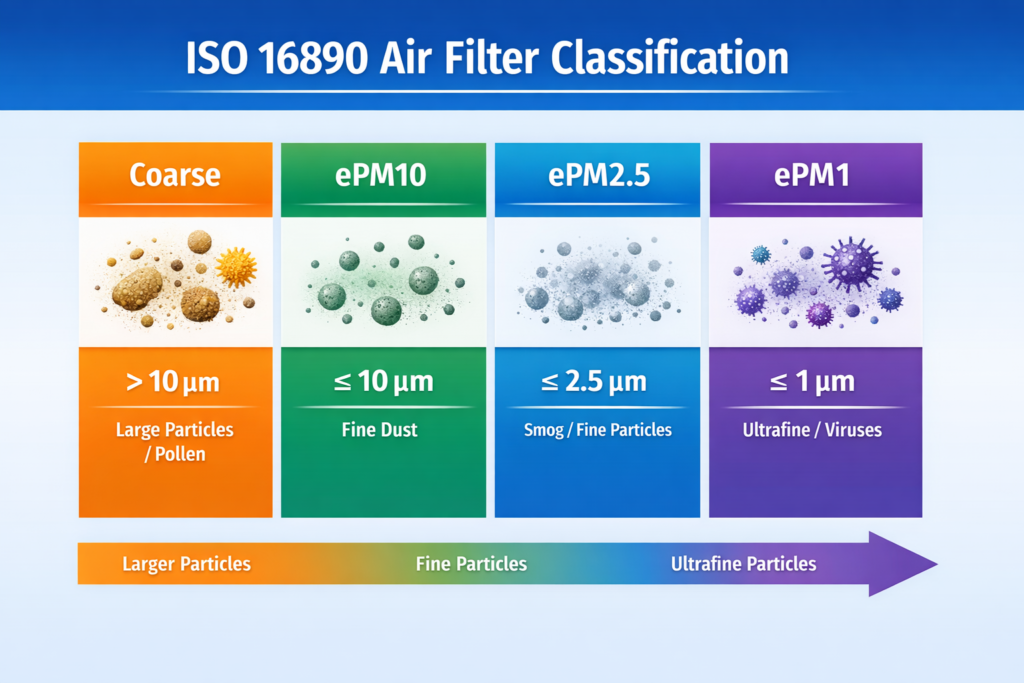
ISO 16890 is an international standard that classifies air filters based on their efficiency in capturing particulate matter (PM) of different sizes.
Unlike previous standards, ISO 16890 evaluates filters using:
- PM1 (≤1 μm)
- PM2.5 (≤2.5 μm)
- PM10 (≤10 μm)
👉 This approach reflects real environmental air pollution, making it more practical and application-oriented.
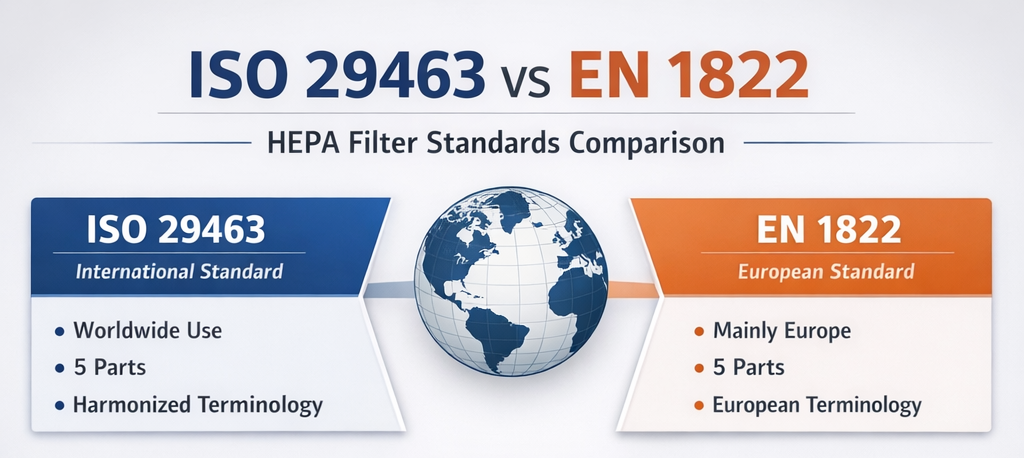
2. Why ISO 16890 Replaced EN 779
Before ISO 16890, the European standard EN 779 was widely used. Sin embargo, it had limitations:
- Focused on synthetic dust instead of real particles
- Did not directly relate to human health
- Provided limited guidance for modern air quality requirements
ISO 16890 solves these issues by:
✔ Using real particle size ranges (PM-based classification)
✔ Linking filter performance to air quality outcomes
✔ Providing globally unified evaluation criteria
3. ISO 16890 Classification System
Filters under ISO 16890 are classified into four main categories:
| Classification | Description | Application |
|---|---|---|
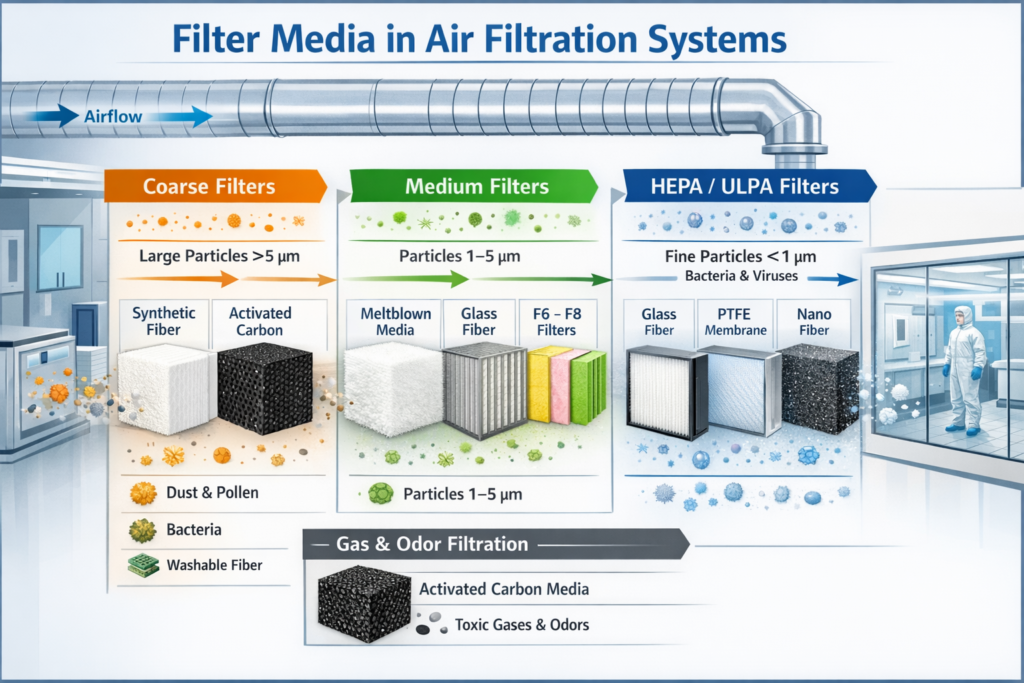
| Coarse | Low efficiency for large particles | Pre-filtration |
| ePM10 | Removes particles ≤10 μm | Basic HVAC |
| ePM2.5 | Removes fine particles ≤2.5 μm | Indoor air quality |
| ePM1 | Removes ultra-fine particles ≤1 μm | High-performance systems |
👉 Example:
A filter labeled ePM2.5 65% removes 65% of PM2.5 particles.
4. How ISO 16890 Testing Works
La ISO 16890 test process includes several key steps:
1) Initial Efficiency Test
Measures filtration efficiency across different particle sizes.
2) Discharge (Conditioning Process)
Removes electrostatic effects to simulate real usage conditions.
3) Dust Loading Test
Evaluates how performance changes as the filter accumulates dust.
4) Final Efficiency Calculation
Calculates average efficiency to determine classification.
👉 This multi-step approach ensures accurate and realistic performance evaluation.
5. Why ISO 16890 Matters
ISO 16890 is important because it directly impacts:
- Indoor air quality (IAQ)
- Energy efficiency (caída de presión)
- System performance and lifespan
For engineers and manufacturers, it provides a reliable basis for filter selection and product development.
6. Practical Applications
ISO 16890 is widely used in:
- Commercial HVAC systems
- Hospitals and healthcare facilities
- Office buildings and airports
- Industrial ventilation systems
It helps ensure that filters are selected based on actual environmental needs, rather than laboratory-only conditions.
7. Testing Equipment for ISO 16890
Accurate testing requires a complete filter test system, incluido:
- Particle generation and measurement
- Airflow control system
- Dust feeding unit
- Data acquisition software
For example, the SC-16890 General Ventilation Filter Test System from SCPUR is designed specifically for ISO 16890 cumplimiento.
It offers:
- Accurate PM1 / PM2.5 / PM10 efficiency measurement
- Stable airflow and dust loading control
- Automated test procedures
- Reliable and repeatable results
👉 Such systems are essential for manufacturers and laboratories aiming to meet international standards.
8. Conclusión
ISO 16890 represents a major advancement in air filter testing by aligning laboratory evaluation with real-world air quality conditions.
By focusing on PM-based classification, it provides a more meaningful way to assess filter performance and select the right solution for modern applications.
👉 Looking for a reliable ISO 16890 test solution? Contact us to learn more about our SC-16890 system and how it can support your testing needs.