In air filtration systems, two key parameters are often discussed together: filtration efficiency y caída de presión.
Understanding the balance between these two factors is essential for optimizing system performance, consumo de energía, and indoor air quality—especially under standards like ISO 16890.
1. What Is Filtration Efficiency?
Filtration efficiency refers to a filter’s ability to capture airborne particles.
Under ISO 16890, efficiency is measured based on:
- PM1
- PM2.5
- PM10
👉 Higher efficiency means better removal of fine particles, which directly improves indoor air quality.
2. What Is Pressure Drop?
Pressure drop is the resistance a filter creates against airflow.
It is measured as the difference in air pressure between:
- Upstream (before the filter)
- Downstream (after the filter)
👉 Higher pressure drop means:
- Increased energy consumption
- Higher load on fans
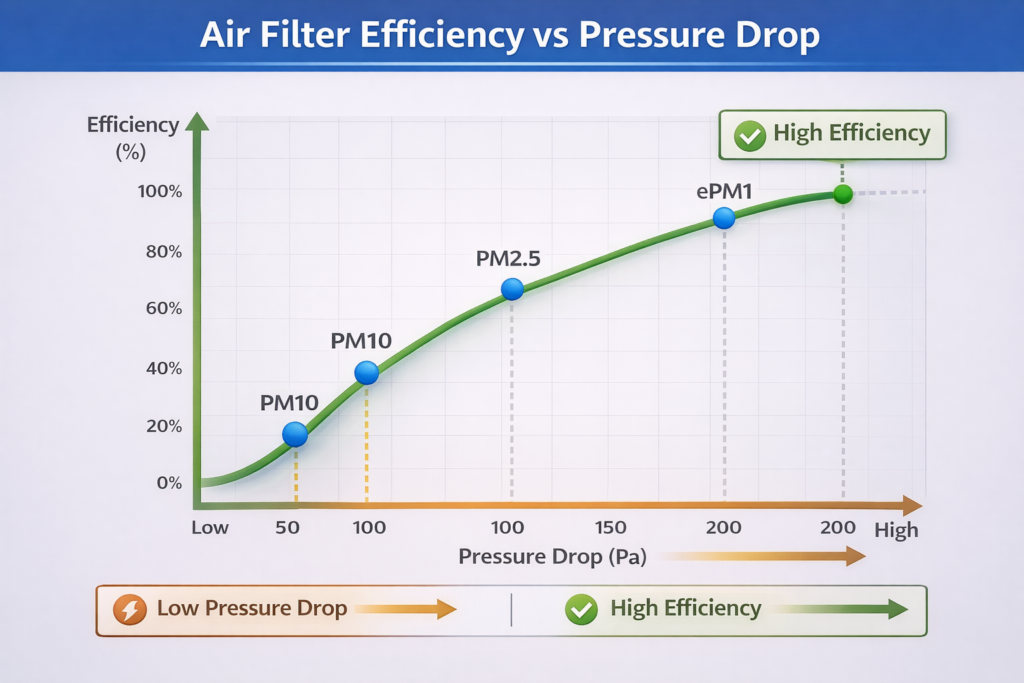
3. The Trade-Off Between Efficiency and Pressure Drop
En la mayoría de los casos:
✔ Increasing filtration efficiency → increases pressure drop
✔ Lower pressure drop → may reduce filtration efficiency
This creates a fundamental trade-off:
| Goal | Impact |
|---|---|
| High efficiency | Better air quality, higher resistance |
| Caída de presión baja | Lower energy use, weaker filtration |
👉 The challenge is to find the optimal balance.
4. Why This Balance Matters
4.1 Energy Consumption
Pressure drop directly affects fan energy use.
- Higher resistance → more power required
- Long-term operating cost increases
4.2 Rendimiento del sistema
Excessive pressure drop can:
- Reduce airflow
- Affect ventilation efficiency
- Shorten system lifespan
4.3 Indoor Air Quality
Low-efficiency filters may fail to capture harmful fine particles such as PM2.5 and PM1.
👉 This impacts health, especially in:
- hospitales
- Offices
- Public buildings
5. How ISO 16890 Helps Optimize the Balance
ISO 16890 improves decision-making by:
✔ Classifying filters based on real particle sizes
✔ Evaluating performance after dust loading
✔ Reflecting real operating conditions
👉 This allows engineers to choose filters that provide both efficiency and acceptable pressure drop.
6. Factors That Influence Efficiency vs Pressure Drop
6.1 Filter Media Structure
- Fiber diameter
- Packing density
- Layer design
👉 Advanced media can achieve high efficiency with lower resistance.
6.2 Airflow Velocity
Higher airflow velocity:
- Increases pressure drop
- May reduce filtration efficiency
👉 Proper system design is essential.
6.3 Carga de polvo
As dust accumulates:
- Efficiency may increase (initially)
- Pressure drop continuously increases
👉 This affects filter lifespan and replacement cycles.
7. How to Optimize Filter Selection
To achieve the best balance:
✔ Select filters based on ISO 16890 clasificación (ePM1 / ePM2.5)
✔ Consider lifecycle cost, not just initial performance
✔ Match filter to application (climatización, cuarto limpio, industrial)
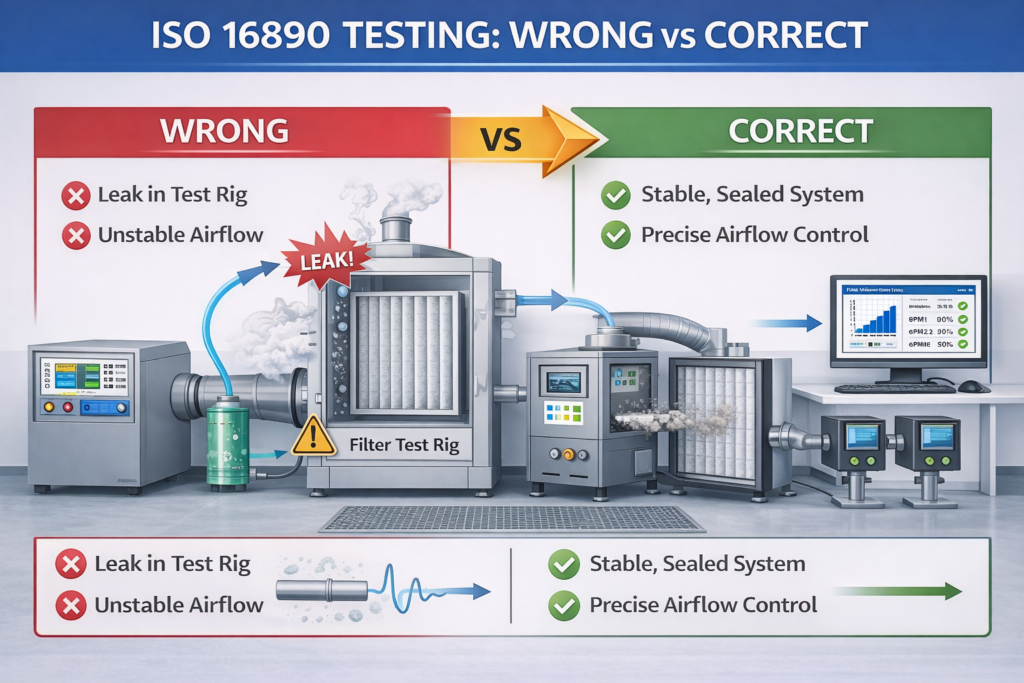
8. Importance of Accurate Testing
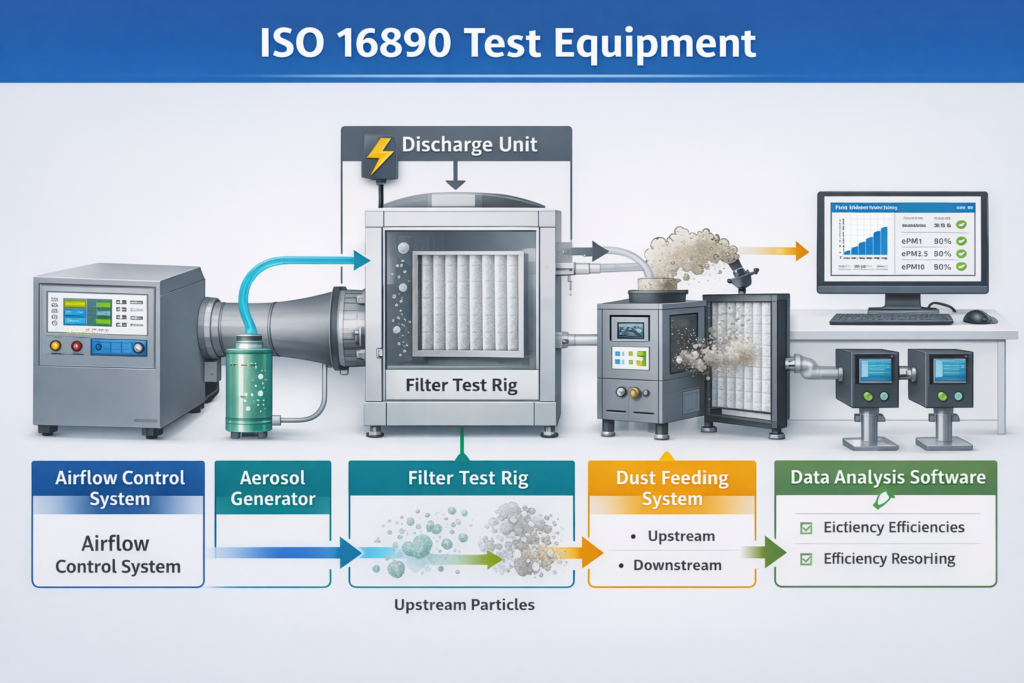
Accurate measurement of both efficiency and pressure drop is critical.
Testing systems must provide:
- Stable airflow
- Precise pressure sensors
- Reliable particle measurement
👉 Any error can lead to incorrect system design decisions.
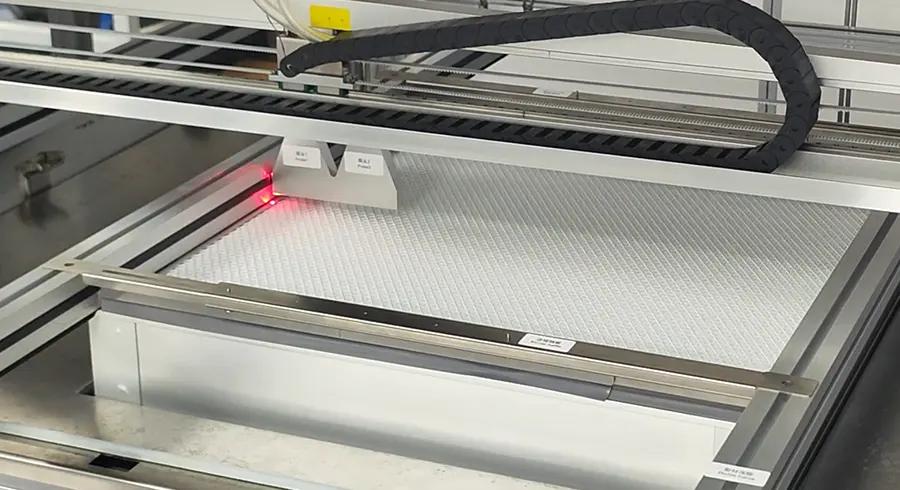
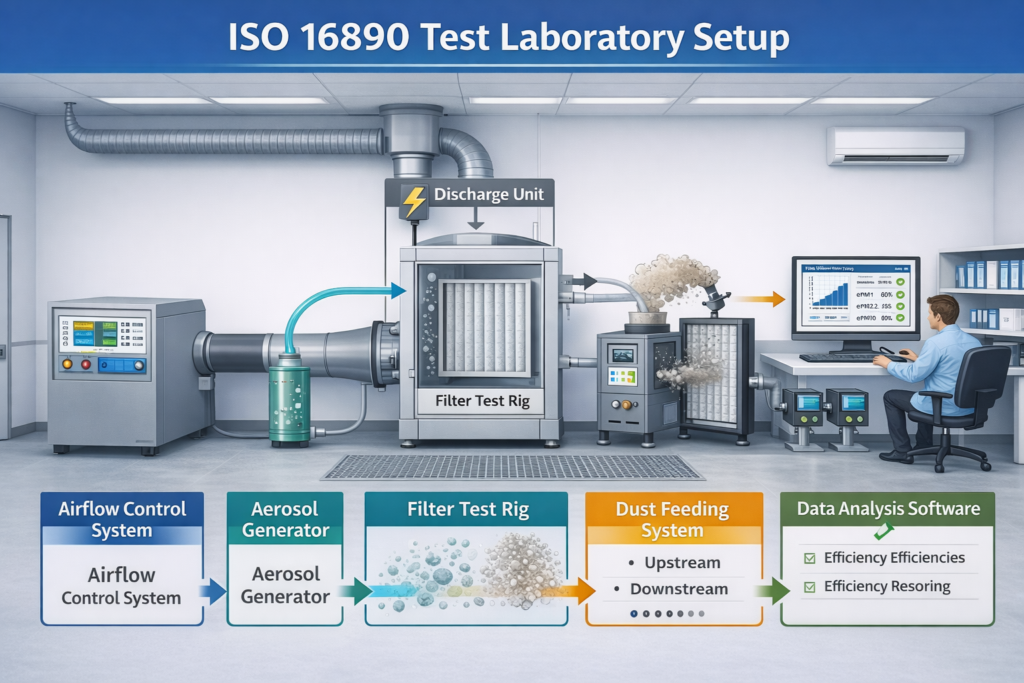
9. Recommended Testing Solution
El SC-16890 Sistema de prueba de filtro de ventilación general from SCPUR enables precise measurement of:
- Eficiencia de filtración (PM1 / PM2.5 / PM10)
- Pressure drop under controlled airflow
- Performance during dust loading
Key Benefits
- High measurement accuracy
- Resultados estables y repetibles
- Integrated testing process
👉 Helps engineers and manufacturers optimize filter performance effectively.
10. Conclusión
Balancing filtration efficiency and pressure drop is one of the most important challenges in HVAC system design.
By using ISO 16890 classification and accurate testing systems, it is possible to achieve:
✔ High air quality
✔ Energy-efficient operation
✔ Reliable long-term performance