It is commonly understood that higher airflow increases face velocity, which tends to reduce filtration efficiency. Conversely, lower airflow (lower velocity) is generally expected to improve efficiency. Jedoch, in practical testing—such as at 500 m³/h—filtration efficiency can sometimes decrease instead. This counterintuitive behavior has been observed by experienced professionals in the filtration industry. Here, we analyze the mechanisms behind this phenomenon and discuss its practical implications.
1. Filtration Mechanisms and Their Relationship to Airflow
Air filtration relies on several mechanisms, each responding differently to airflow:
| Mechanism | Effective for Particle Size | Response to Airflow |
|---|---|---|
| Diffusion | Ultrafine particles (<0.3 μm) | More effective at lower airflow |
| Interception | Mid-sized particles | Less sensitive to airflow |
| Inertial Impaction | Large particles (>0.5 μm) | More effective at higher airflow |
| Gravitational Settling | Large particles, low relevance in HEPA | Minimal effect |
For HEPA and similar filters, diffusion is the dominant mechanism for particles near the Größte Durchdringungspartikelgröße (MPPS). In theory, lower airflow should enhance diffusion and improve overall efficiency.
2. Why Efficiency Can Drop at Very Low Airflow
Despite the theoretical expectation, several practical and physical factors can cause efficiency to decrease at ultra-low flow rates:
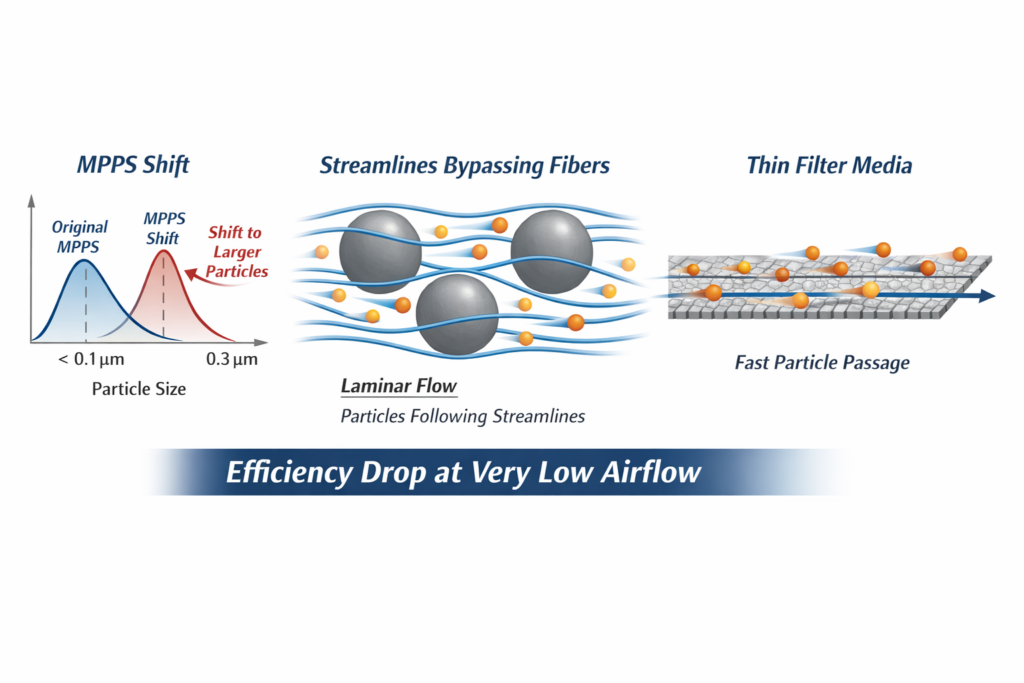
a. MPPS Shifts to Larger Particle Sizes
At very low face velocities, the MPPS may shift toward slightly larger particle sizes (z.B., closer to 0.3 μm). Since diffusion becomes less effective for these larger particles, and inertial mechanisms are suppressed at low speeds, overall filtration efficiency can decline.
b. Particle Streamlines May Bypass Fibers
Ultra-low airflow often leads to laminar and highly stable streamlines. Particles may follow these streamlines, passing through the filter without significant interaction, especially in filters with larger pore sizes or widely spaced fibers.
c. Filter Media May Not Be Optimized for Low Flow
Some glass fiber or synthetic media are engineered for standard or moderate airflow. At very low velocities, diffusion may not dominate, limiting capture efficiency.
d. Uneven Flow Distribution
Low airflow reduces turbulence and mixing, potentially causing uneven particle distribution across the filter surface. Localized underperformance can reduce measured efficiency.
e. Thin or Shallow Filter Media
For relatively thin filters, longer particle residence time at low airflow does not always translate to more fiber contact. Particles may pass through without significant deviation, limiting filtration effectiveness.
3. Practical Implications
While lower airflow can theoretically enhance filtration via diffusion, real-world performance depends on:
- Filter media structure
- MPPS characteristics
- Flow dynamics across the filter
In some cases, especially with specific materials or thin filters, efficiency may decline at ultra-low face velocities, such as 500 m³/h. Therefore, when testing filters under non-standard flow conditions, results must be interpreted in the context of filtration physics—not just raw numbers.
For detailed guidance on HEPA/ULPA filter testing, or to discuss your specific filtration requirements, our technical team is ready to assist.