High-efficiency air filtration plays a critical role in cleanrooms, healthcare environments, and industrial applications. To ensure consistent performance, HEPA filters must comply with internationally recognized standards.
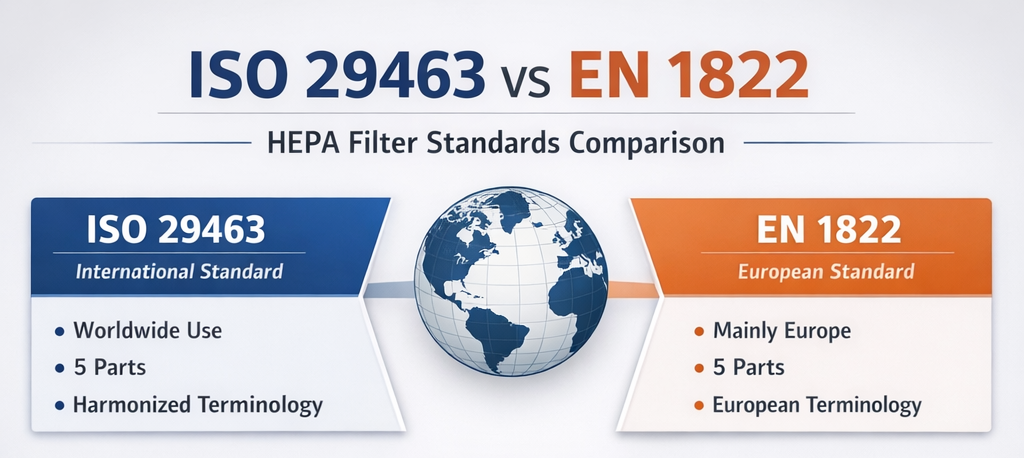
Two of the most widely used standards are ISO 29463 Und IN 1822. While they are closely related, there are important differences in testing methods, classification systems, and global adoption.
This article provides a clear comparison to help you understand their similarities and differences.
1. Overview of HEPA Filter Standards
IN 1822 (European Standard)
IN 1822 is a European standard that defines the classification and testing of HEPA and ULPA filters based on their performance at the Größte Durchdringungspartikelgröße (MPPS).
It is widely used in:
- Europe
- Cleanroom industries
- Pharmaceutical and semiconductor sectors
ISO 29463 (International Standard)
ISO 29463 is the international standard derived from EN 1822 and expands its scope for global use.
It provides:
- Harmonized testing methods
- Global classification system
- Applicability across different industries and regions
2. Key Similarities
Both standards share the same fundamental principles:
- Classification based on MPPS efficiency
- Requirement for overall efficiency and local leak testing
- Use of aerosol-based testing methods (z.B., DEHS, PAO)
- Focus on high-performance filtration (HEPA & ZORN)
👉 In practice, ISO 29463 can be seen as an international extension of EN 1822.
3. Key Differences Between ISO 29463 und EN 1822
| Aspect | ISO 29463 | IN 1822 |
|---|---|---|
| Scope | International | European |
| Structure | 5 parts (more comprehensive) | 5 parts |
| Terminology | Globally harmonized | Europe-focused |
| Anwendung | Worldwide industries | Mainly Europe |
| Updates | More recent and evolving | Earlier foundation |
4. Classification Comparison
Both standards classify filters based on efficiency at MPPS:
| Class | Efficiency (MPPS) |
|---|---|
| E10 | ≥ 85% |
| E11 | ≥ 95% |
| E12 | ≥ 99.5% |
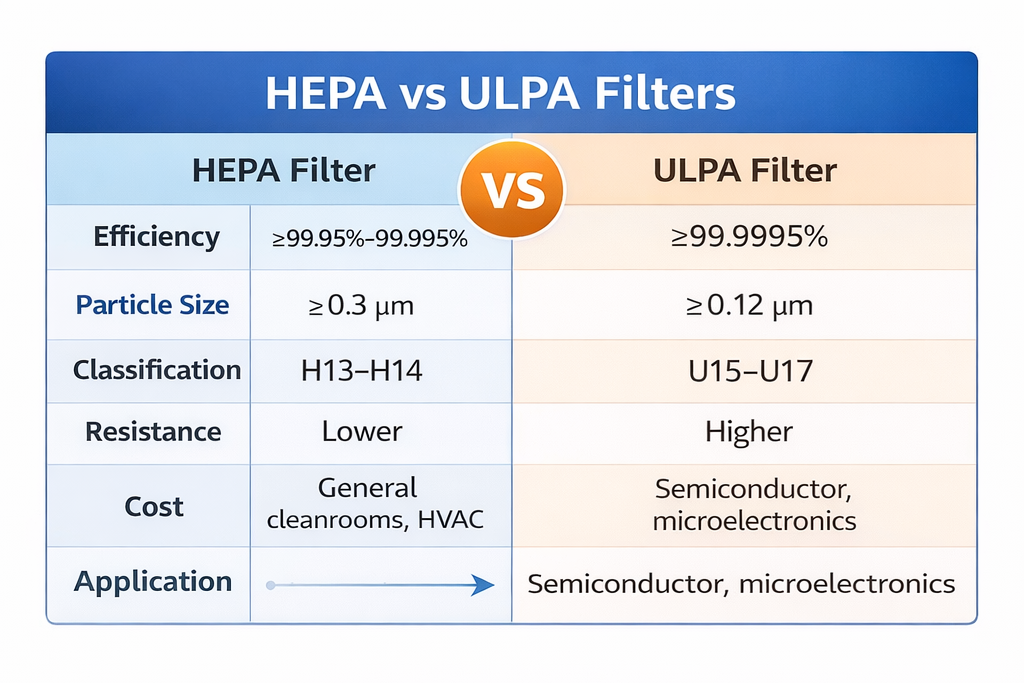
| H13 | ≥ 99.95% |
| H14 | ≥ 99.995% |
| U15–U17 | ≥ 99.9995% and above |
✔ ISO 29463 adopts essentially the same classification system as EN 1822, ensuring compatibility between the two standards.
5. Testing Methods
Both standards require two critical tests:
1) MPPS Efficiency Test
- Determines the lowest filtration efficiency
- Defines the filter classification
2) Leak Test (Scan Test)
- Detects local defects in the filter media
- Ensures no bypass leakage
These tests are essential for ensuring filter reliability in critical environments such as cleanrooms and hospitals.
6. Why These Standards Matter
Choosing the correct standard ensures:
- Compliance with international regulations
- Reliable filtration performance
- Protection of sensitive environments
For manufacturers, understanding both standards is crucial when exporting products globally.
7. Testing Equipment for HEPA Standards
To comply with ISO 29463 Und IN 1822, accurate testing equipment is required.
Typical systems include:
- Filter media test systems
- Automated filter test benches
- Scanning leak test systems
Zum Beispiel, advanced testing platforms can:
- Measure MPPS efficiency precisely
- Perform high-resolution leak scanning
- Ensure compliance with both standards
8. Abschluss
IN 1822 remains the foundation for HEPA filter testing, while ISO 29463 extends it into a globally unified standard.
In most cases:
👉 Their testing principles and classification systems are aligned
👉 The main difference lies in scope and international applicability
Understanding both standards helps manufacturers, Labore, and end users ensure consistent and compliant filtration performance worldwide.