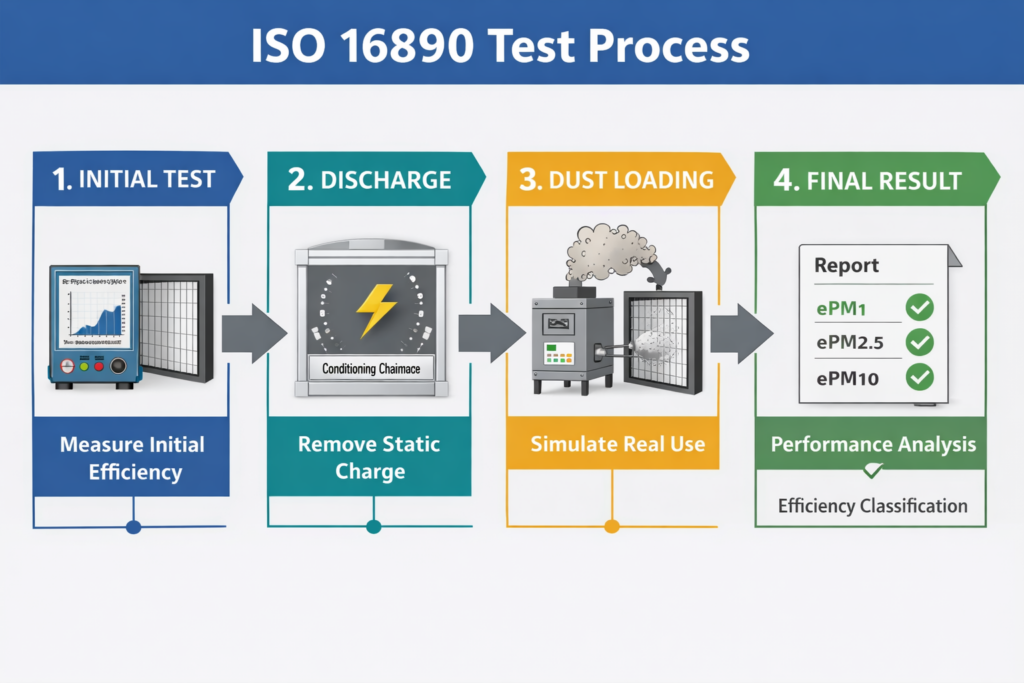
Accurate testing under ISO 16890 is essential for reliable air filter classification. Tuttavia, in real-world laboratories, many errors can affect test results and lead to incorrect conclusions.
In this article, we highlight the most common ISO 16890 testing mistakes—and how to avoid them.
1. Unstable Airflow Control
Problem
Airflow fluctuations during testing can significantly affect filtration efficiency and pressure drop measurements.
Impact
- Inconsistent test results
- Scarsa ripetibilità
- Incorrect classification
Soluzione
✔ Use a system with precise and stable airflow control
✔ Regularly calibrate airflow sensors
2. Inaccurate Particle Measurement
Problem
Particle counters may produce inaccurate readings due to poor calibration or incorrect positioning.
Impact
- Wrong PM1 / PM2,5 / PM10 efficiency
- Misleading performance data
Soluzione
✔ Use high-precision particle measurement systems
✔ Ensure proper upstream/downstream sampling
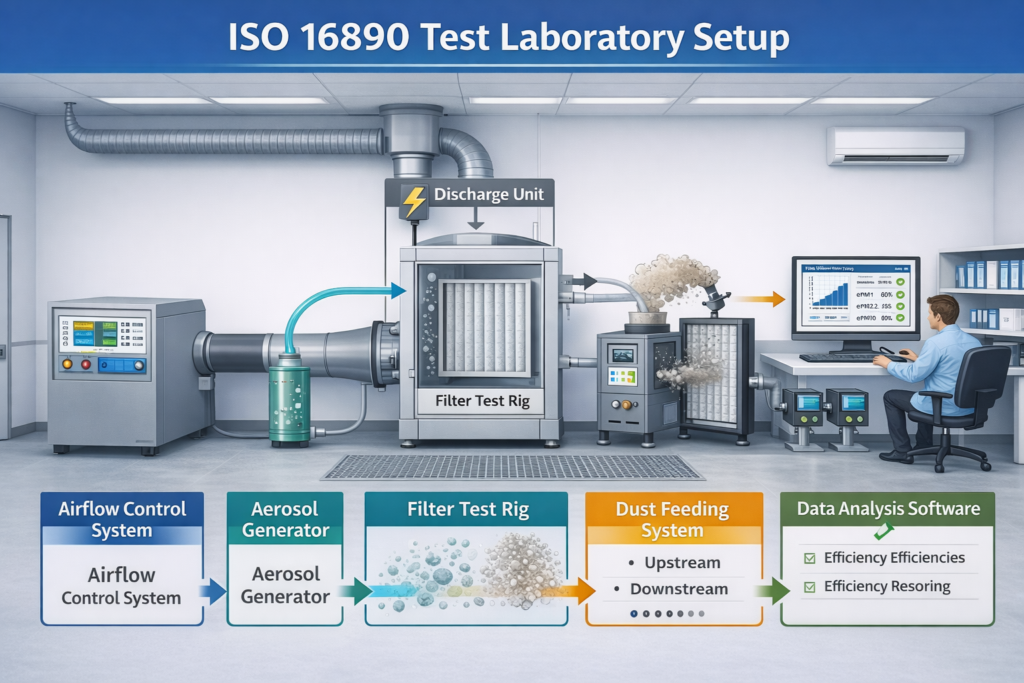
3. Ignoring the Discharge Process
Problem
Some laboratories skip or improperly perform the discharge (condizionata) step.
Impact
- Overestimated efficiency
- Non-compliance with ISO 16890
Soluzione
✔ Always perform proper discharge
✔ Use integrated conditioning systems
👉 This step is critical to simulate real-world filter performance.
4. Inconsistent Dust Feeding
Problem
Unstable or uneven dust feeding during loading tests.
Impact
- Irregular pressure drop curve
- Unreliable efficiency trend
Soluzione
✔ Use automated and controlled dust feeding systems
✔ Monitor dust concentration continuously
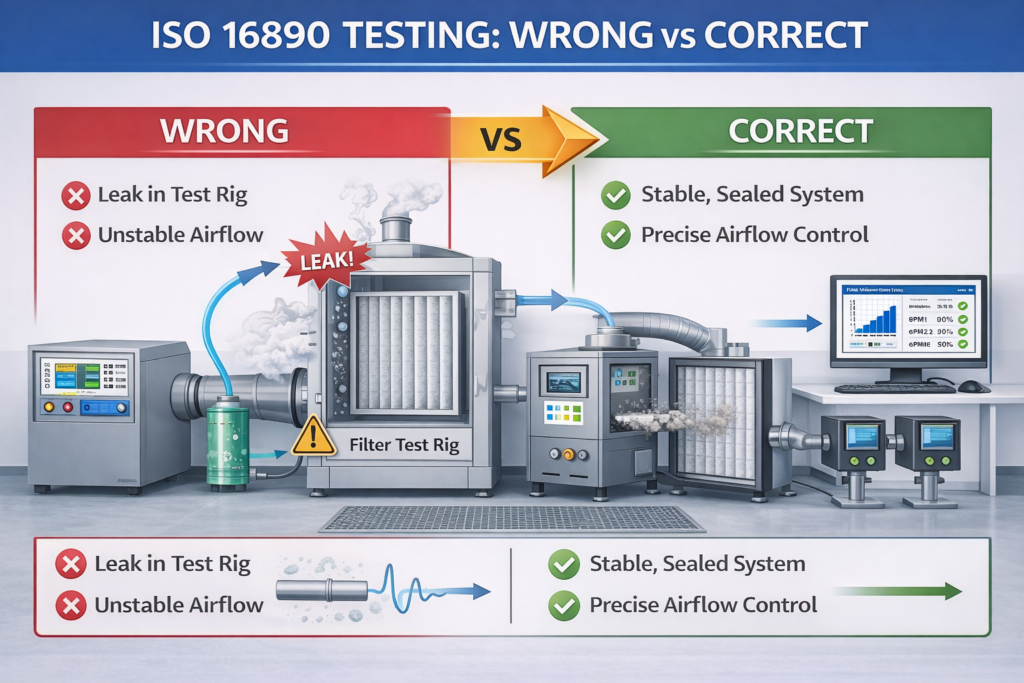
5. Poor Test System Sealing
Problem
Air leakage in the test rig can bypass the filter.
Impact
- False low efficiency results
- Incorrect classification
Soluzione
✔ Ensure proper sealing of the test system
✔ Perform regular leak checks
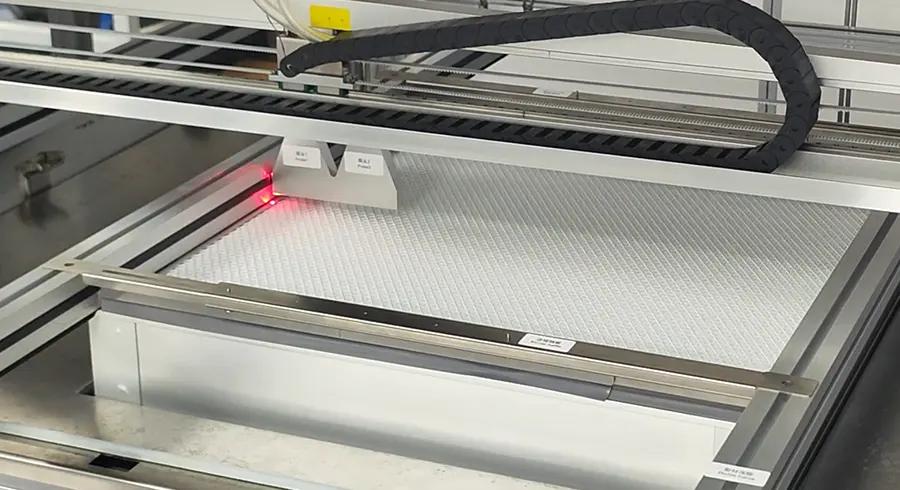
6. Incorrect Filter Installation
Problem
Improper installation or positioning of the test filter.
Impact
- Air bypass
- Non-representative results
Soluzione
✔ Use standardized fixtures
✔ Ensure correct mounting and alignment
7. Lack of System Calibration
Problem
Failure to regularly calibrate sensors and instruments.
Impact
- Long-term data drift
- Reduced accuracy
Soluzione
✔ Schedule periodic calibration
✔ Maintain calibration records
8. Environmental Factors Ignored
Problem
Temperature and humidity variations are not controlled.
Impact
- Affects particle behavior
- Impacts measurement stability
Soluzione
✔ Maintain stable lab conditions
✔ Use environmental control systems
9. Low Automation Leading to Human Error
Problem
Manual operation increases variability and errors.
Impact
- Scarsa ripetibilità
- Time-consuming testing
Soluzione
✔ Use automated testing systems
✔ Reduce operator dependency
10. Using Non-Compliant Test Equipment
Problem
Some systems do not fully meet ISO 16890 requisiti.
Impact
- Invalid test results
- Certification issues
Soluzione
✔ Choose fully compliant systems
✔ Verify system capabilities before testing
11. Recommended Solution for Reliable Testing
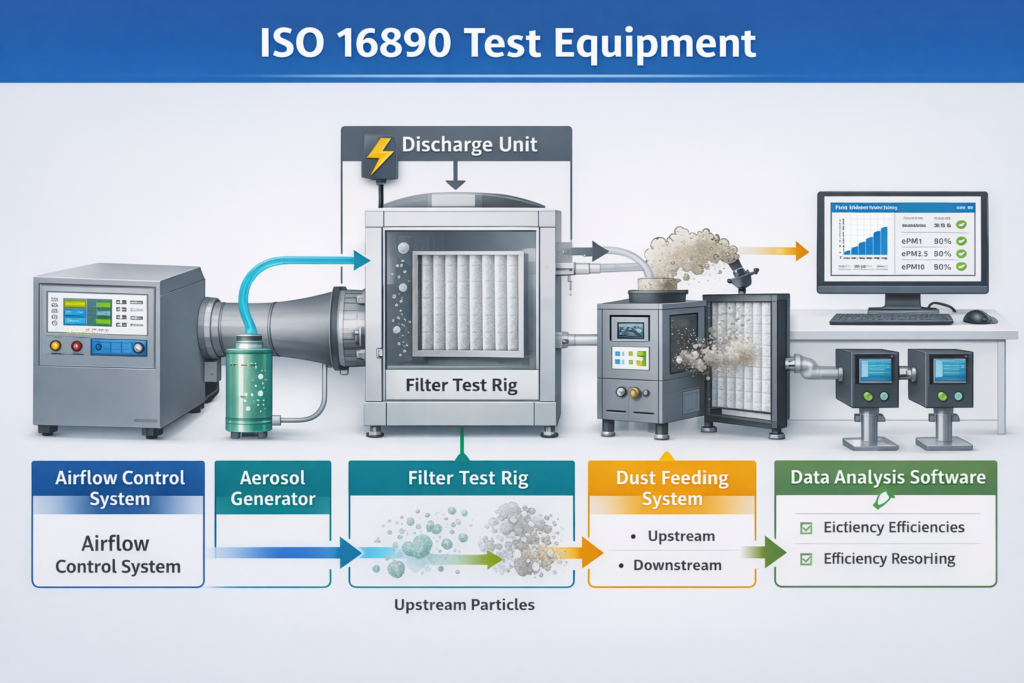
To avoid these common issues, a professional testing system is essential.
IL SC-16890 Sistema di test generale del filtro di ventilazione from SCPUR is designed to eliminate these problems.
Key Benefits
- Controllo stabile del flusso d'aria
- Accurate particle measurement
- Integrated discharge system
- Automated dust loading
- High repeatability
👉 Helps ensure accurato, consistent, and compliant test results.
12. Conclusione
ISO 16890 testing requires not only understanding the standard but also avoiding common operational and system-related mistakes.
By addressing these issues and using the right equipment, laboratories can ensure:
✔ Reliable data
✔ Accurate classification
✔ Conformità agli standard internazionali
👉 Facing issues with ISO 16890 test? Contact us to get expert support and reliable testing solutions.