Air filtration plays a critical role in maintaining indoor air quality across HVAC systems, industrial environments, and commercial buildings. To ensure reliable performance, general air filters must be evaluated according to standardized testing methods and classification systems.
This article provides an overview of testing standards, filter classification, and test rig systems, helping manufacturers and laboratories select the right solutions for performance validation.
1. What Are General Air Filters?
General air filters are primarily used in HVAC and ventilation systems to remove airborne particles such as:
- Dust
- Pollen
- Fine particulate matter (PM10, PM2.5, PM1)
Unlike HEPA filters, general ventilation filters focus on real-world particle size distribution, making their testing standards more application-oriented.
2. Key Testing Standards for General Air Filters
2.1 ISO 16890
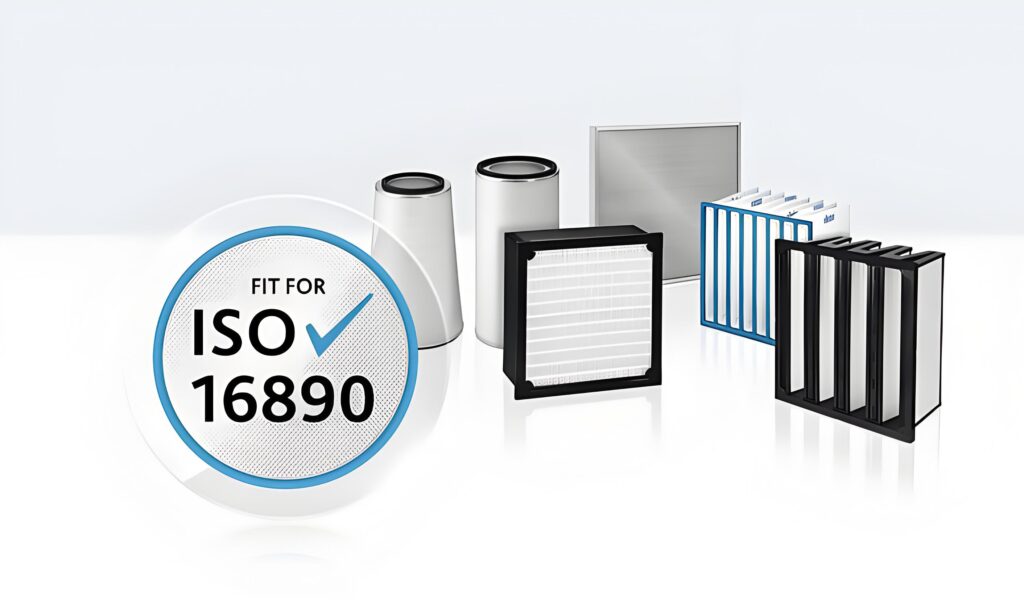
The ISO 16890 standard is currently the most widely adopted global standard for general ventilation filters.
Key features:
- Classifies filters based on PM1, PM2.5, and PM10 efficiency
- Reflects real atmospheric dust conditions
- Replaces older standards like EN 779
Classification system:
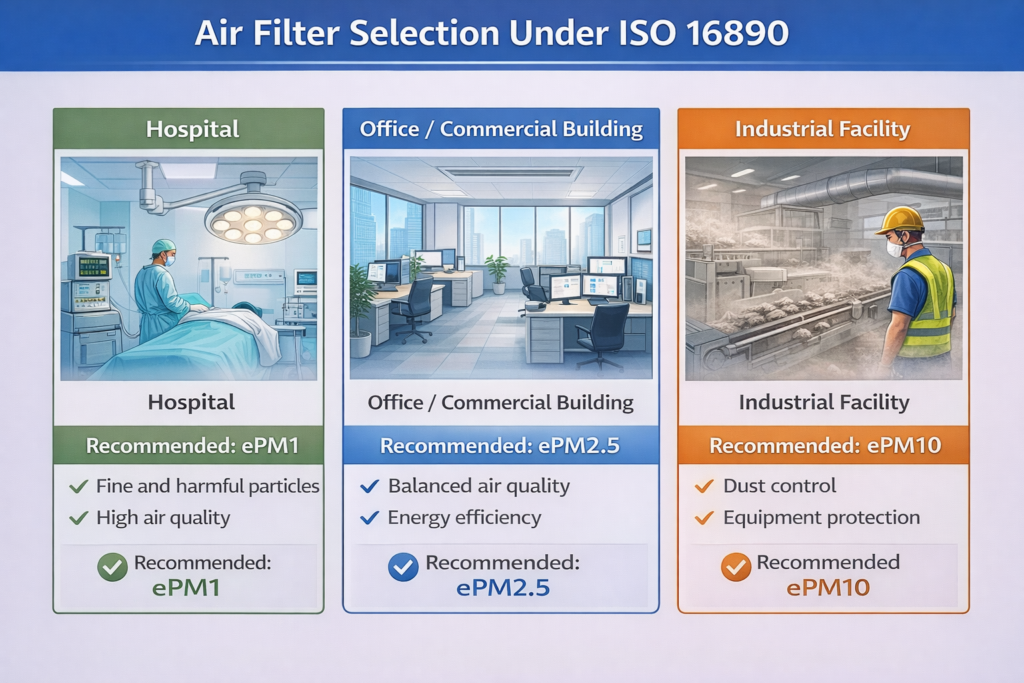
- ePM1
- ePM2.5
- ePM10
- Coarse
👉 This standard provides a more realistic evaluation compared to traditional methods.
2.2 EN 779 (Legacy Standard)
EN 779 was previously used in Europe, classifying filters as:
- G1–G4 (coarse filters)
- F5–F9 (fine filters)
Although now largely replaced by ISO 16890, it is still referenced in some markets and legacy systems.
3. Filter Classification Overview
Modern classification focuses on particle size efficiency, rather than only arrestance:
| Classification | Particle Size Range | Application |
|---|---|---|
| Coarse | >10 μm | Pre-filtration |
| ePM10 | ≤10 μm | Commercial HVAC |
| ePM2.5 | ≤2.5 μm | Indoor air quality control |
| ePM1 | ≤1 μm | High-performance ventilation |
This shift allows engineers to better match filters with real environmental requirements.
4. Test Methods and Key Parameters
To evaluate general air filters, several parameters are measured:
4.1 Filtration Efficiency
- Based on particle size distribution
- Measured across multiple size ranges
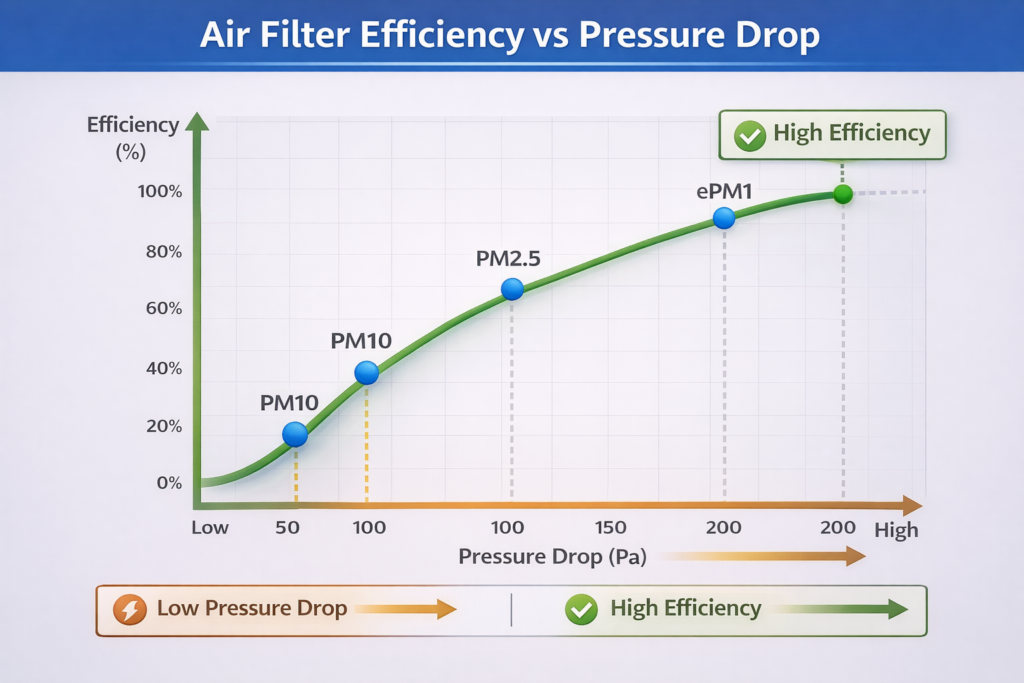
4.2 Pressure Drop
- Indicates airflow resistance
- Directly impacts energy consumption
4.3 Dust Holding Capacity
- Determines service life
- Evaluated through loading tests
4.4 Discharge/Conditioning Process
- Required in ISO 16890
- Simulates real operating conditions
5. Test Rig Systems for Air Filter Evaluation
A complete air filter test system typically includes:
- Aerosol generation system
- Particle measurement instruments
- Airflow control system
- Dust feeding system
- Data acquisition software
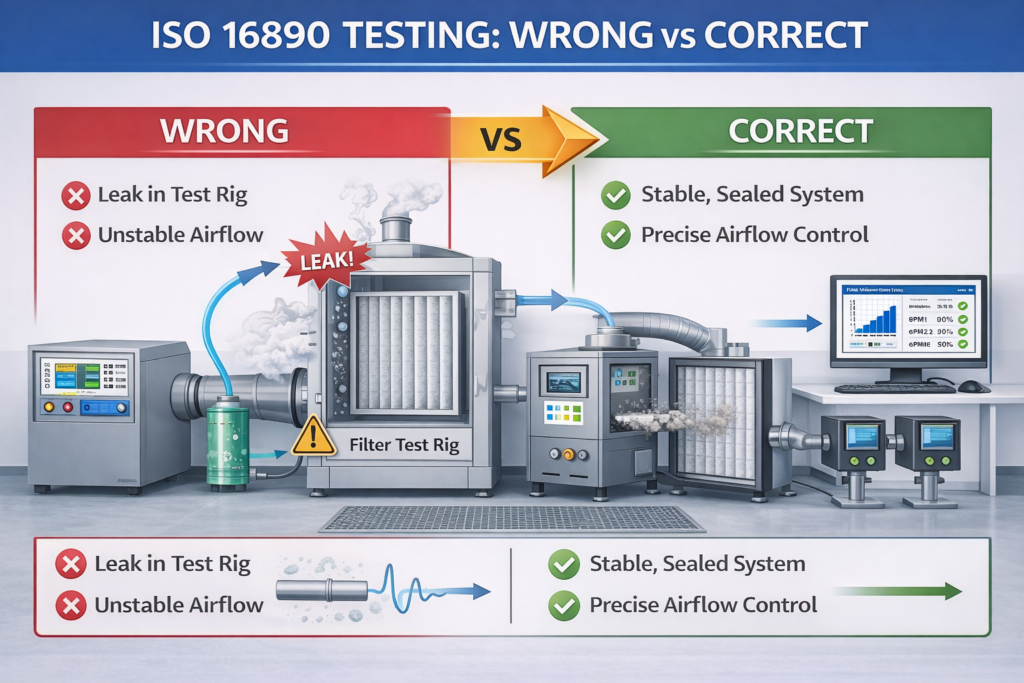
These systems must provide:
✔ Stable airflow control
✔ Accurate particle measurement
✔ Repeatable test conditions
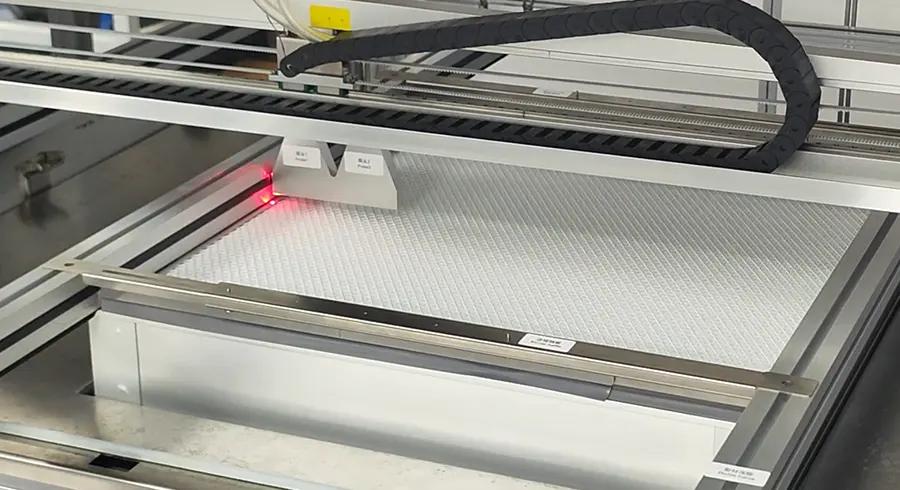
6. Recommended Solution: SCPUR SC-16890 Test System
For laboratories and manufacturers seeking compliance with ISO 16890, the
SC-16890 General Ventilation Filter Test System from SCPUR is a highly reliable solution.
Key Advantages
- Fully compliant with ISO 16890
- Accurate PM1 / PM2.5 / PM10 efficiency measurement
- Automated test procedures for improved consistency
- Stable airflow and dust loading control
- User-friendly software for data analysis
Typical Applications
- HVAC filter manufacturers
- Third-party testing laboratories
- Research institutions
- Quality control departments
👉 The SC-16890 system ensures precise, repeatable, and standards-compliant testing, helping users improve product quality and meet international requirements.
7. Why Proper Testing Matters
Accurate testing of general air filters ensures:
- Compliance with international standards
- Improved indoor air quality
- Reduced energy consumption
- Better product competitiveness
For manufacturers, investing in advanced test systems is essential to remain competitive in the global market.
8. Conclusion
With the adoption of ISO 16890, general air filter testing has shifted toward more realistic, particle-based evaluation methods.
Understanding testing standards, classification systems, and selecting the right test rig—such as the SC-16890—are critical steps in ensuring reliable filter performance and market compliance.